Showing posts with label ACFS fundraiser. Show all posts

Cuban Five T-shirts on sale now!  


Cuba Five T-shirts:

Join the campaign to free the Cuban Five
Help us spread the word, buy and wear a
Men and Women sizes, t-shirt $ 20 P/H included in Australia.

Methods of payment: EFT to ACFS WA bank account
Post a money order/chq to ACFS WA. PO BOX 1455 WA 6951
Orders: acfsperth@gmail.com or call 0419812872

Posted by Picasa

Read More...
AddThis Social Bookmark Button

ACFS Raffle  

Dear ACFSers: The photos below show a photograph by Cuban photographer Brayan Collazo. His work is the first prize for our annual ACFS Perth raffle for 2011. The raffle will be drawn on Saturday 23rd July 2011 at the Santiago de Cuba Carnival to be held at Kulcha in Fremantle. A celebration has been organised with local band Latin Fusion at KULCHA from 8pm. For more information visit: http://www.kulcha.com.au/ or send us an email to: acfsperth@gmail.com Raffle tickets are $5 each, get as many as you can to increase your chances of owning this fantastic prize. Get your raffle tickets early to avoid disappoitment. All proceeds to go to support the oncology unit of Las Tunas provincial hospital in Cuba.


Order your tickets by phone: 0419812872 or by email: acfsperth@gmail.com or write to us to ACFS: PO BOX 1455 South Perth, WA 6951 In friendship, Vinnie Molina Branch President
Posted by Picasa

Read More...
AddThis Social Bookmark Button

Public meeting with Cuban educator Ezequiel Morales  

Public meeting:
Listen to Cuban Educator Ezequiel Morales.
Saturday 9 April, 4-7 pm @ the MUA, North Fremantle
Entry by gold coin donation

The Australia Cuba Friendship Society is pleased to be hosting Ezequiel Morales from ICAP Cuba. We would like to invite you to a public meeting to welcome him and get first hand information about education and life in Cuba.

Please join us on the 9th April at the Maritime Union of Australia, MUA rooms in North Fremantle, 2-4 Kwong Alley cnr Queen Victoria Avenue from 4:00pm. (See Flyer attached for details and to distribute to your networks).

Ezequiel was born to a peasant family and spent his early years before the Revolution cleaning shoes and selling cakes in order to help support his family and to pay a ‘teacher’ to tutor in reading and writing. He was eight years old when the revolution triumphed and from then on he was able to attend a School Centre.

His vocation as a teacher began in 1961 when he joined the Cuban Literacy Campaign and at only ten years old taught illiterate peasants how to read and write. Since that time he has dedicated most of his career to the education sector as a teacher and later as a union leader. Ezequiel has participated in the continuous improvement of the National System of Education as a member of the Team of Authors.

Since 1996 Ezequiel has worked with the Cuban Institute for Friendship with the Peoples (ICAP) and has become well known to Australian brigadistas joining the Southern Cross Brigade each year as the official translator.

His mastery of the English language has been very useful to carry out his work as a political official at ICAP, being able not only to lecture on many subjects, but also to serve as interpreter for a great number of outstanding personalities. In November 2007, he joined the 59th Global Edition Voyage of the Peace Boat. On this occasion, he was invited by the Japanese Organisation Peace Boat, to travel on the Japanese Cruise from Spain to Cuba, to deliver lectures on board to regular audiences of more than 400 people.

In Friendship,
Elizabeth Hulm
Branch Secretary
ACFS Perth
0421113343

Read More...
AddThis Social Bookmark Button

Perth Celebrates the 26th July Assault on the Moncada Barracks  

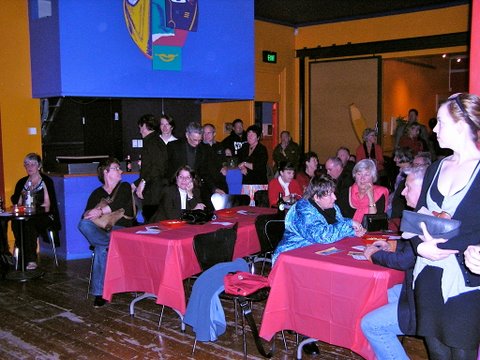
On Saturday 24th July the city of Fremantle in Western Australia wore the colours of the Cuban Revolution. The Australia-Cuba Friendship Society (ACFS) threw a big Revolution party, a unique event for Perth.

The party kicked off with a warm welcome from Cuban ambassador to Australia, Mr Abelardo Curbelo, who kindly accepted the invitation to visit Western Australia for the celebrations. He highlighted the significance of the historical event, the spark of the Cuban revolution, in the city of Santiago de Cuba which sees the town shut down its activities for a week to dance the days and nights away to rhythms of Cuban music.

Almost 200 people attended the big revolution party which featured local band Latin Fusion. ACFS secretary Elizabeth Hulm talked to people about the aims of the friendship society in Perth that for 16 years has been strengthening the friendship between the peoples of Australia and Cuba.

She told the attendees that it is only their solidarity that would enable the ACFS to raise the dollars needed to fund this year’s project in the province of Las Tunas, Cuba. ACFS Perth is currently sponsoring the rebuilding of the local school for children with special needs whose dream is to attend the Paralympics sometime in the future.

Branch president Vinnie Molina invited those present to visit Cuba in the upcoming Southern Cross brigade to Cuba due on Boxing Day. He also talked on the plight of the Cuban Five men unjustly incarcerated in US prisons for no crime and whom are unable to get visits by their wives.  The night ended at midnight with a chant of Viva Cuba!


Read More...
AddThis Social Bookmark Button

ACFS group booking at Che film premiere  

CHE Film - with Australia Cuba Friendship Society 6:00 PM
Please join the Australia Cuba Friendship Society for the opening of the Benicio Del Toro film on the life of Che Guevara at the cinema Paradiso in Northbridge on Thursday 1st October -- The evening will commence at 6:00pm with greetings from the Branch President of the Society followed by the latest hits from Guatemalan singer/songwriter Carlos Castellanos --- The film starts at 6:30pm with drinks and nibbles to follow for those who wish to stay on after the film. Tickets are available now by ringing Vinnie on 0419 812 872 or Elizabeth 0421 113 443 - Bookings and tickets available now! please dont miss out as numbers are limited -- Prices: $15 ($20 solidarity) All proceeds to go to Las Tunas Children's hospital in Cuba -- Please collect your raffle door ticket at the door and try your luck for a surprise Cuban prize.

Vinnie Molina ACFS president 0419812872

Read More...
AddThis Social Bookmark Button

Review of new Che Guevara film  

Join ACFS at the opening night in Perth on October 1, 6.30pm, Paradiso.
Email: acfsperth@gmail.com for details


Che Film in two parts
Film directed by Steven Soderburgh
Review by Richard Titelius

According to the notes accompanying the release of the movie there were 7 years of research and filming undertaken to make this movie of the life of Che in two parts which comes in at just over four hours.

Upon seeing the movie one will be struck by the efforts taken to present a historically accurate, passionate and compelling rendition of the life of arguably the world’s most iconic revolutionary.

The movie received its world premier at the Cannes Film Festival in May 2008, for which Benicio Del Toro received the award for Best Actor for the colourful, engaging and serious portrayal of the Argentine physician who went on to lead the Cuban revolution with Fidel Castro in the 1950’s.

The movie has gone on to receive mixed reviews around the world where the First World bourgeois media feels compelled to acknowledge the icons enduring legacy in front of the rest of the world, while also pandering to those who support its capitalist interests which Che fearlessly denounced on their own soil and in front of their own institutions.

The movie played to mild protests from Cuban expatriates at its opening in Miami and on the other side of the Florida Straits a few days later in November 2008, the movie played to a strong ovation, according to the official Cuban media Granma.

The movie has been released in Australia and is unlikely to receive much interest from the Cinema multiplexes around Australia and will spend much of its release in art house cinemas where its thoughtful and difficult though universal themes of justice, freedom and liberty will receive a more receptive audience.

The movie starts with the auspicious meeting of Fidel Castro (Mexican actor Demian Bichir) and Ernesto “Che” Guevara in the home of a Cuban friend in Mexico City in July 1955.

The movie follows in tone and sentiment with 2004’s “The Motorcycle Diaries” which traced the journey of the young Che Guevara with his friend Alberto Granado from Argentina, through Chile and Peru and eventually to Venezuela. It was on this trip that the young Che saw the harsh conditions and exploitation under which many people lived in the Latin continent and awoke in him the fierce desire to change the material conditions under which these people lived.

Soderburgh’s Che then passes from Mexico City to the southern shores of Cuba via the good ship Granma and on to the mountains of Sierra Maestra where the revolutionaries scored their first significant victories.

Part I alternates in grainy black and white film to the occasion in 1964 when Che visited the United States and gave an interview to the US media and delivered a passionate and fiery speech to the UN General Assembly on the resolve of the Cuban people.

The movie has its strong portrayals of battle with the armed forces of the government of Fulgencio Batista though these battles do not glorify war or violence in any way but show that a people who want justice, liberty and a better life must be prepared to fight those who will use violence including torture and other deprivations to resist the struggle of the people for a better life.

The movie contrasts with the texture of the usual Hollywood movies about the wars fought in the interests of capital where the protagonists of the conflicts and its soldiers have little interest in bringing freedom, justice and a better life to the lands where the wars are fought. In this sense Che the movie is the antithesis of most war movies (the wars of imperialism) where the protagonists of these movies are usually seen engaged in destruction and messing around with the women and messing up themselves. In this war Che makes it clear that any revolutionary can leave at certain times if they are not ready or able to continue and are given explicit instructions about the rules of engagement with the masses and the consequences for transgression which can include death. The revolutionaries also take care of the wounded of their enemy as well as their own.

The first part of the movie was shot in Cuba itself and the smaller part actors are peppered with the accents of indigenous Cuban actors and the vegetation and buildings in the towns and countryside are also reminiscent of a recent visit to Cuba-as are the old yet immaculately kept US cars from the late 1940’s and 1950’s which adorn the set in the urban settings. Part II is shot in Bolivia and Spain.

Part I of the movie concludes as the army buoyed by their victory in Santa Clara head on to the final victory in Havana.

If the tone of this Part I is predominantly upbeat as one knows the outcome of the Cuban Revolution, the tone of the second part is grim and forbidding though still engaging as is the enigma that surrounds much of this period of Che’s when he withdrew from his posts in Cuba and went to Bolivia.

He went there ostensibly to start the liberation of South America where the oppression and contradictions were at their greatest.

The colour and setting are more austere in Bolivia in line with the tone or theme of this part of Che’s life.

Though Fidel Castro had advised his comrade and friend against going to Bolivia as the timing was not right and to wait for things to calm down, it was Che who said to Fidel in Mexico at the start of their adventures together that if the Cuban campaign was successful that he did not want to be stopped from taking the revolution to Argentina and Bolivia.

However, almost as soon as he got there he found that he did not have the support of the Bolivian Communist Party, partly because they did not trust a foreigner, notwithstanding that Simon Bolivar who helped liberate Bolivia from the Spanish in the 19th Century was also a foreigner from Venezuela.

The film follows the errors and disappointments of the Bolivian campaign, as Che and his Bolivian, Cuban and other Latin revolutionaries find their mission becoming increasingly compromised and unable to build a better world where children no longer have to work in mines and the average miner will live longer than 30 years.

The complicity of the USA in the fate of Che which feared another Revolution in Bolivia similar to Cuba, is well featured in the movie and includes a special appearance of Matt Damon as a negotiator.

The end of the movie is tense, dramatic and unpredictable though not the typical Hollywood fare notwithstanding that this is a Hollywood movie.

Though Che the revolutionary and freedom fighter died an ignoble end without seeing his dream of a revolution coming to Bolivia, ironically 40 years later, it would be a native from Bolivia, Evo Morales and the Movement Towards Socialism (MAS) who would herald in a better world for the majority of Bolivians and they would remember Che at this time.

19th September 2009

Read More...
AddThis Social Bookmark Button